



AresLite DM40P: The Four-Wavelength Non-Crystal Diode Laser That Eliminates Skin Type Restrictions
Redefining Clinical Standards: The AresLite DM40P Non-Crystal Diode Laser Hair Removal Machine
In the rapidly evolving landscape of medical aesthetics, the demand for versatile, high-performance laser hair removal platforms has never been more acute. Clinic owners and medical practitioners are no longer satisfied with single-wavelength devices that limit their client base or require cumbersome consumable replacements. The AresLite DM40P Non-Crystal Diode Laser Hair Removal Machine represents a significant engineering leap, designed to address the core pain points of modern aesthetic practices: treatment efficacy across all skin types, operational efficiency, and long-term return on investment. This machine is not merely an incremental upgrade; it is a strategic asset for clinics aiming to dominate the hair removal segment.
At the heart of the DM40P lies a fundamental technological departure from conventional laser systems. The term “Non-Crystal Diode” is not marketing jargon but a reference to the laser bar architecture. Traditional diode lasers often rely on crystal substrates that can degrade over time, leading to power inconsistency and reduced lifespan. The DM40P employs a monolithic, non-crystal diode array that delivers a staggering 2000W of peak power. This architecture ensures that every pulse is delivered with precise energy uniformity, from the first shot to the 100 millionth. For the clinician, this translates to predictable, repeatable results session after session, without the dreaded “power drop-off” that plagues older generation lasers.
Why Four Wavelengths Are Non-Negotiable for Modern Practice
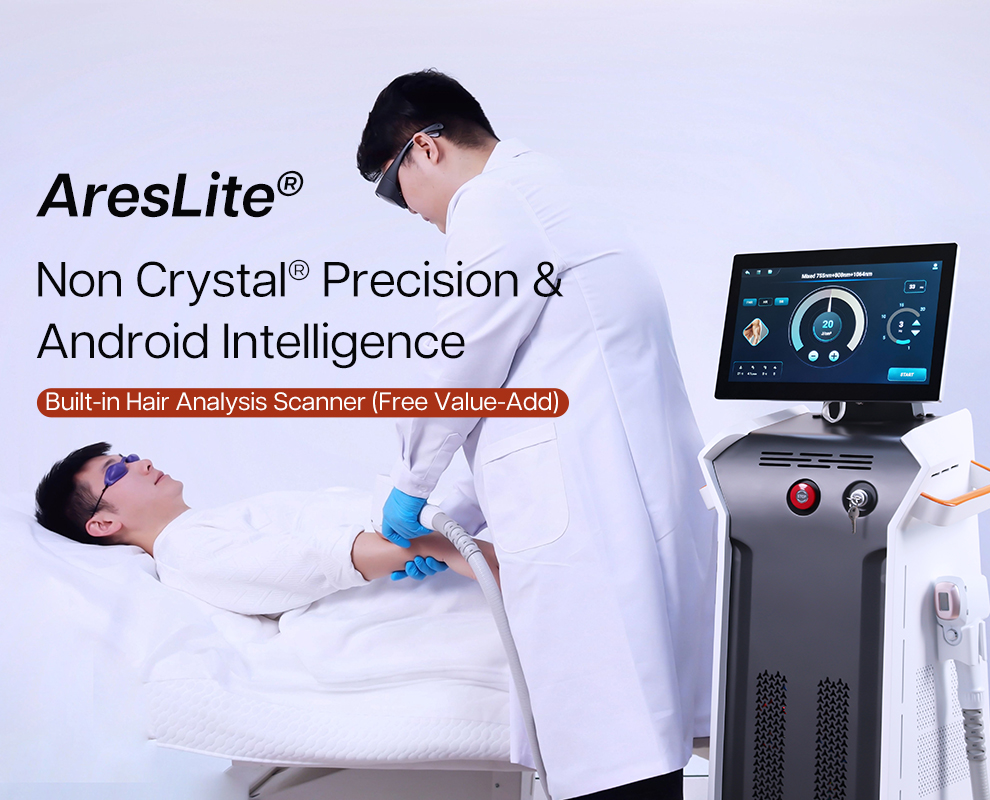
The DM40P is equipped with a quad-wavelength engine: 755nm, 808nm, 940nm, and 1064nm. While many devices claim multi-wavelength capability, the DM40P utilizes these wavelengths in a synchronized, stacked emission profile. This is not a simple switch between different lasers; it is a sophisticated energy delivery system that leverages the unique absorption characteristics of each wavelength simultaneously. Understanding why this matters requires a brief dive into chromophore biology.
Melanin, the primary target for laser hair removal, has a broad absorption spectrum. The 755nm Alexandrite wavelength is exceptionally well-absorbed by melanin, making it highly effective for fine, light-colored hair on lighter skin types (Fitzpatrick I-III). However, its high melanin affinity also increases the risk of epidermal burn on darker skin tones. The 808nm diode wavelength sits in a “sweet spot,” offering deep penetration with good melanin absorption, making it the workhorse for most patients. The 940nm wavelength targets the deeper dermal layers and has a higher affinity for water and hemoglobin, which aids in targeting the hair bulb and papilla while simultaneously coagulating surrounding blood vessels. This reduces post-treatment erythema and speeds up recovery. Finally, the 1064nm Nd:YAG wavelength is the gold standard for Fitzpatrick IV-VI skin types. Its deep penetration bypasses the melanin-rich epidermis, delivering energy directly to the hair follicle without causing surface burns.
The DM40P’s proprietary pulse technology allows these four wavelengths to be emitted in a single, millisecond-length pulse. This creates a “stacked” effect where the 755nm pre-heats the hair shaft, the 808nm and 940nm deliver the bulk of the thermal destruction to the bulb, and the 1064nm ensures deep vascular coagulation and safety for the epidermis. The result is a treatment that is simultaneously more effective and safer than any single-wavelength approach. For a clinic, this means you can treat a fair-skinned blonde patient in the morning and a dark-skinned patient with coarse hair in the afternoon, using the same handpiece, without changing settings or compromising safety. This capability alone expands your addressable market by an estimated 40-60% compared to a single-wavelength device.
DCS 5-in-1 Cooling: The Thermal Management Revolution
High-power diode lasers generate immense heat. Without advanced thermal management, the laser diodes would degrade rapidly, and the contact cooling tip would fail to protect the epidermis. The DM40P introduces the DCS 5-in-1 Cooling System, a multi-stage thermal management architecture that represents the current pinnacle of cooling technology in aesthetic lasers. The acronym DCS stands for Dynamic Cooling System, but its five components deserve individual examination.
First, the system integrates a semiconductor cooler, which provides the initial Peltier-effect heat transfer from the sapphire tip to the internal heat sink. This is the first line of defense for patient comfort. Second, a compressor-based refrigeration cycle, similar to that found in medical-grade chillers, circulates refrigerant to maintain a stable base temperature. Third, forced air convection through strategically designed heat sinks dissipates the bulk heat load from the compressor and power supply. Fourth, a closed-loop water circulation system acts as a thermal battery, absorbing heat spikes during high-frequency pulse trains and preventing temperature fluctuation. Fifth, and most critically, a TEC (Thermoelectric Cooler) module provides precision temperature control at the handpiece tip, allowing the clinician to set the contact cooling temperature anywhere from -45C to +5C.
The ability to achieve -45C at the treatment tip is a game-changer. At this temperature, the epidermis is effectively cryo-anesthetized before the laser pulse even fires. This allows for higher fluence delivery with virtually no pain, eliminating the need for topical numbing creams in most patients. The clinical implications are profound: reduced treatment time (no waiting for cream to take effect), higher patient satisfaction, and the ability to treat sensitive areas like the upper lip, bikini line, and underarms with confidence. Furthermore, the DCS system is engineered for continuous operation. Unlike older systems that require a “cool-down” period after a certain number of shots, the DM40P can maintain its cooling performance indefinitely, even at the highest pulse frequencies.
Ergonomics and Operational Intelligence
The DM40P is configured with two distinct handpieces, each designed for specific anatomical regions. The first handpiece features a fixed 12x12mm spot size. This square spot is ideal for precision work on smaller areas such as the chin, upper lip, sideburns, and fingers. The smaller spot size concentrates energy into a smaller area, allowing for higher fluence delivery when needed. The second handpiece features a 12x24mm rectangular spot. This larger footprint is optimized for speed on larger anatomical areas like the legs, back, chest, and arms. The rectangular shape also allows for better contact with curved body surfaces, reducing the “rocking” motion that can cause uneven energy delivery.
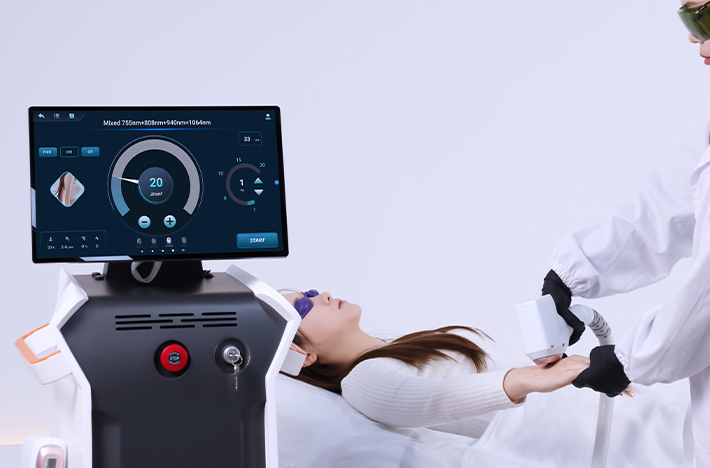
Both handpieces incorporate a handle-integrated touch screen. This is a significant ergonomic advancement. Rather than requiring the clinician to look away from the treatment area to adjust parameters on a separate console, the DM40P allows for real-time adjustment of pulse frequency (from 1Hz to 20Hz), fluence, and pulse width directly on the handpiece. The intuitive interface displays preset treatment protocols for different skin types and body areas, which can be customized and saved. The 20Hz maximum pulse frequency is exceptionally high for a 2000W system. At 20Hz, the DM40P can deliver 20 shots per second, enabling a skilled clinician to treat a full back in under 15 minutes. This speed is a direct driver of clinical throughput and revenue.
Regulatory Credentials and Quality Assurance
In the B2B medical device market, regulatory clearance is not a luxury; it is a prerequisite for purchasing. The DM40P carries significant regulatory weight. It holds FDA 510(k) clearance under number K241860. This clearance is specific to the device’s indication for permanent hair reduction and pseudofolliculitis barbae (razor bumps), and it confirms that the device has been reviewed by the FDA for safety and effectiveness. Furthermore, the device is CE MDD certified, specifically by ENC Lab, which is recognized as a Notified Body under the European Medical Device Directive. This certification is essential for clinics operating in the European Economic Area and many other regions that recognize CE marking.
Beyond device-level certifications, the manufacturing facility itself is ISO 13485 certified. ISO 13485 is the international standard for quality management systems in the design and manufacture of medical devices. This certification ensures that every DM40P is built in a controlled environment with rigorous traceability, risk management, and post-market surveillance protocols. For the clinic owner, these certifications mitigate liability risk, simplify compliance with local health authority regulations, and provide confidence that the device will perform as advertised. The rated laser bar lifespan of 100 million shots further underscores the build quality. At an average of 2000 shots per full-body treatment, this lifespan translates to approximately 50,000 full-body treatments before any laser bar replacement is needed, which is effectively the lifetime of the device in a busy clinic.
Return on Investment: The Financial Case for the DM40P
Any capital equipment purchase in aesthetic medicine must be justified by a clear ROI model. The DM40P presents a compelling financial case. Consider a mid-volume clinic performing 15 hair removal treatments per day, five days per week. At an average price of $350 per full-body treatment (a conservative estimate for many markets), the daily revenue from a single DM40P is $5,250. With a typical 60% gross margin on laser treatments (accounting for consumables, staff time, and overhead), the daily gross profit is approximately $3,150. Over a 250-day working year, this yields a gross profit of $787,500 from a single device.
The key differentiator for the DM40P is its ability to treat all skin types. A clinic limited to Fitzpatrick I-III patients is leaving over half the market untapped. By adding the DM40P, a clinic can immediately accept patients with darker skin tones (Fitzpatrick IV-VI) who were previously referred elsewhere. This expands the potential patient base without increasing marketing spend proportionally. Furthermore, the DCS cooling system eliminates the need for topical anesthetic, which costs approximately $5-$15 per treatment and adds 20-30 minutes of chair time. By eliminating this step, the DM40P increases chair utilization by at least 20%, directly boosting revenue per square foot.
The non-crystal diode technology also reduces total cost of ownership. Traditional crystal-based diodes often require bar replacement at 30-50 million shots. The DM40P’s 100 million shot lifespan effectively halves the long-term capital replacement cost. Additionally, the robust DCS cooling system reduces the likelihood of overheating-related service calls. When factoring in the expanded patient base, reduced consumable costs, and lower maintenance expenses, the DM40P typically achieves a payback period of 4-6 months in a busy practice.
DM40P vs. DM60: Strategic Positioning in the Product Line
To fully appreciate the DM40P, it is useful to understand its position relative to the flagship DM60 model. The DM60 is a higher-output system, typically featuring a 2400W or greater power supply and additional handpiece options, including a larger 40x40mm spot size for ultra-rapid full-body treatments. The DM60 is designed for high-volume, multi-room clinics and medical spas that perform dozens of hair removal treatments daily. Its larger spot size allows for even faster treatment times, but it comes at a significantly higher acquisition cost.
The DM40P is strategically positioned as the “professional workhorse” for solo practitioners, small to medium-sized clinics, and as a secondary room device in larger chains. It offers the same quad-wavelength technology, the same DCS cooling system, and the same FDA clearance as the DM60. The primary trade-off is in maximum spot size and peak power. For most clinics, the 12x12mm and 12x24mm handpieces are more than adequate. The 12x24mm spot, in particular, offers excellent speed for large areas. The DM40P also has a smaller physical footprint and lower power consumption, making it easier to integrate into existing treatment rooms without electrical upgrades.
For the clinic owner evaluating the two, the decision hinges on volume. If you anticipate more than 25 treatments per day per device, the DM60’s speed advantage may justify the premium. If you are a growing practice with 10-20 treatments per day, the DM40P offers the same clinical outcomes and technological sophistication at a more accessible price point. It is also an excellent choice for a second room, allowing you to standardize on one treatment protocol across all devices.
Practical Purchasing Advice for Clinic Owners
Before finalizing a purchase of the AresLite DM40P, consider the following practical steps to ensure a successful acquisition.
- Conduct a thorough site assessment. The DM40P requires a dedicated 20-amp circuit in most configurations. Verify that your treatment room’s electrical supply meets the manufacturer’s specifications. Inadequate power delivery is the most common cause of performance issues in high-power lasers.
- Request a live, in-clinic demonstration. Do not rely solely on marketing materials. Have the manufacturer’s representative perform a treatment on a staff member or a model with Fitzpatrick V skin. Observe the cooling performance, the speed of the 20Hz pulse rate, and the ease of use of the handle-integrated touch screen.
- Negotiate a comprehensive warranty and service agreement. Given the complexity of the DCS cooling system, ensure that the warranty covers the compressor, TEC module, and laser bar for at least two years. Clarify the response time for on-site service and the availability of a loaner device if repairs are needed.
- Validate the training program. The DM40P’s quad-wavelength technology requires proper training to maximize safety and efficacy. Ensure that the manufacturer provides on-site, hands-on training for at least two clinicians, and that ongoing technical support is available via phone or video conference.
- Calculate your true ROI using your own numbers. Use your clinic’s average treatment price, current patient volume, and estimated capture rate of new skin types. Do not rely on generic ROI calculators. A spreadsheet model that accounts for your specific overhead, staff costs, and marketing expenses will give you a realistic payback period.
- Verify the FDA 510(k) clearance number. You can search K241860 on the FDA’s 510(k) database to confirm the device’s clearance status and intended use. This due diligence protects you from purchasing an unregistered device. For more information or to request a quotation, contact us for a personalized consultation.
The AresLite DM40P Non-Crystal Diode Laser Hair Removal Machine represents a sophisticated convergence of photonics engineering, thermal management, and clinical usability. For the discerning clinic owner, it offers a rare combination of broad patient applicability, exceptional safety margins, and a clear path to profitability. By investing in this technology, you are not merely buying a laser; you are acquiring a platform that can define the standard of care in your practice for the next decade.